'Neighborhood ingenuity' saved horses
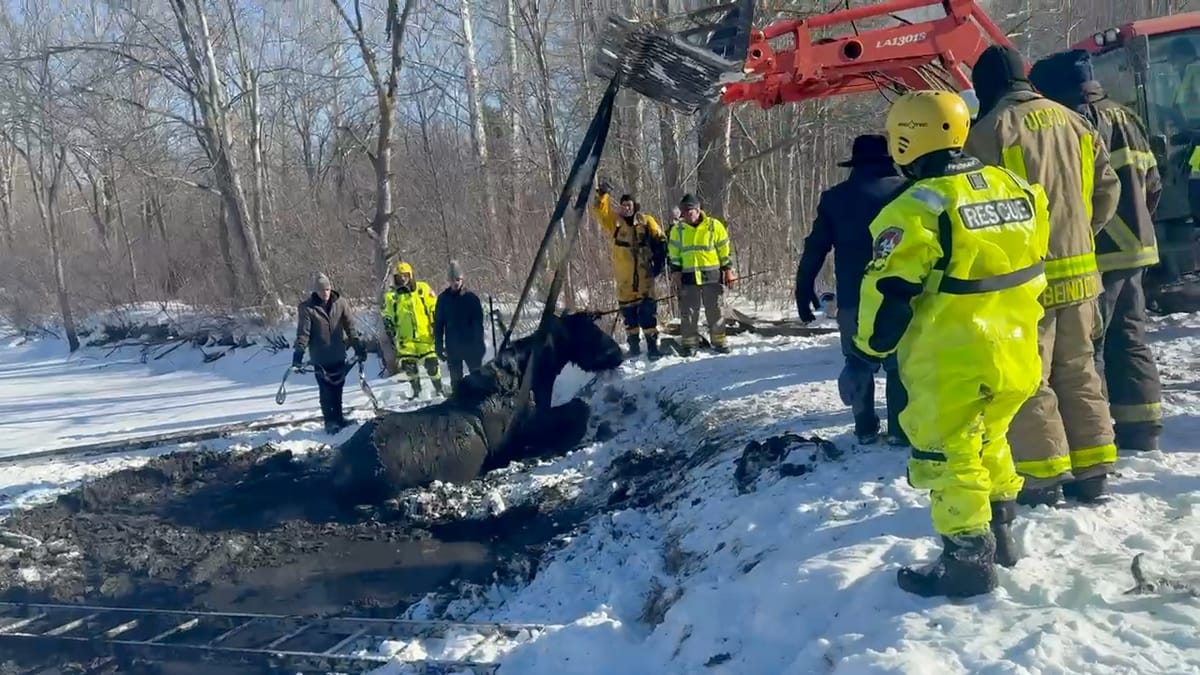
Four horses got stuck in an icy pond on Sunday, Feb. 1.
Four horses broke through an icy pond inside a Calhoun County golf course. A volunteer dive team and firefighters pulled them out. The dive team’s supervisor spoke to The Michigan Hoof Beat about the equipment the team could use and their love of animals.
When members of a volunteer dive team heard that horses were stuck in a frozen pond, they didn’t hesitate: yes, they wanted to help firefighters free the animals. It was an effort that brought together several groups, neighbors, and the proverbial “phone tree” to solve the cold, mucky problem.
Lt. Chris Young didn’t make it to the scene but was “dialed in” to the situation. Young is the Emergency Management Coordinator for the Calhoun County Sheriff’s Office and is the liaison between the sheriff’s office and Area Law Enforcement Underwater Recovery Team (ALURT), the dive team that responded.
The Michigan Hoof Beat spoke with Young about the Sunday, Feb. 1, rescue of four horses in Calhoun County.
The horse owner called their fire department for help after finding the horses stuck in a frozen pond on the Turtle Creek Golf Course in Burlington, Young said. The horses had reportedly escaped their enclosure the night before. Young didn’t know how they’d escaped.
Firefighters called dispatch, dispatch called the fire chief, and the fire chief authorized a “tone” (a term that refers to a radio notification for emergency responders). Then a sheriff’s deputy reached out to Young.
“So I called in and said, ‘Let the fire chief know Dive Team’s available to help—if he wants us,’” Young recalled. “She said, ‘Hang on.’ Came back, said, ‘Yes, send them.’”
Young was with his girlfriend, north of Hastings, and wouldn’t make it to the scene for about an hour and a half, he estimated. Dive team members said they could handle it without him there, though they kept communicating throughout.
“And my girlfriend is also a horse person, so I said to her, ‘Any advice to give these boys’—and girls, we have females (on the dive team),” Young recalled. “She did some internet research, and she came up with a video on strapping underneath the front legs.”
While Young gave his girlfriend credit as the horse person, he’s a horse-owner himself, having bought a weanling in December.
Young forwarded the video to the on-scene crews.
“They watched it on scene, and they were like, ‘Oh, okay, that works.”
A deputy from the mounted unit was also on the scene to help coordinate.
Pulling the horses out of the mud and ice
Rescuers faced two different situations. One horse was treading water, having broken through the ice farther from shore. The other three were stuck in mud in shallow water.
Firefighters and farmers worked to free the three horses stuck in the mud. Young said two farmers brought in tractors with buckets to help with leverage.
ALURT dive team members helped the two-year-old horse that had broken through to deeper water. They went into the water with the horse to place straps around the torso.
[The below video shows rescue teams in Canada learning a strap placement technique on a dummy horse.]
When rescuers began applying pressure to the straps, the horse thrashed.
“One of them got . . . kneed in the head,” Young says. “He’s ok.”
The rescue team pulled the horse out of the hole and onto its back on the ice, then dragged it along.
“He got up. They put new blankets on all of them and walked them off,” Young says. “They all got up on their own accord.”
Other than the two-year-old that had falled into the water, Young didn't have details on the horses ages, breeds, gender or names.
Unlikely that fees will be assessed for horse rescue
When The Michigan Hoof Beat spoke with Young, it sounded unlikely that fees or fines would be assessed against the horse owner.
“I don’t think there’s any need,” Young said.
It wasn’t a law enforcement call, Young said. While there was an on-scene deputy who was also a member of the volunteer mounted unit (the posse), she was there as a support mechanism, Young said. Still, if she’d had any concern, she would have launched an investigation.
While Young didn’t know the exact cause of the escape or how long the animals had been in the water, he noted that the owner showed clear concern, provided new, clean, dry horse blankets, and returned the animals to a warm barn.
“We run on loose horses frequently throughout the year,” Young said. “I mean, it just happens, you know? They're curious creatures.”

You're reading the free version of The Michigan Hoof Beat. To support horse-focused independent journalism in Michigan and ensure that stories like this can keep coming to your inbox, upgrade your subscription.
Community steps up
In a rural community like Burlington Township, people know and help each other, Young said. The firefighters know who is nearby and might have helpful equipment, and the phone tree begins.
“It was pretty fast. I mean, they got them out pretty quick,” Young said. “And, you know, it's just neighborhood ingenuity, quite honestly—and a little bit of guidance from some videos.”
Preventing equine icy water emergencies
Young advised horse owners to fence off ponds in pastures.
Horses don’t understand ice, he said. The flat surface of a frozen, snowy pond just looks like any other flat surface, he explained.
Then, when the weather transitions between warm and cold spells, the ponds can also develop deep, mucky mud where the horses can become stuck.
“Fence those bodies of water in your pastures off,” Young emphasized, noting that he sees unfenced ponds in pastures all the time during his drive between Calhoun County and Barry County and calling the sight “aggravating.”
In this video, courtesy of the Calhoun Co. Sheriff's Office, rescuers from area fire departments and a volunteer dive team pull a horse from a muddy, frozen pond on Feb. 1, 2026 in Calhoun County.
Volunteer dive team loves animals
ALURT is a 501c(3) organization, with divers coming from all walks of life, Young said; an engineer in the automotive industry, a physician, a heavy equipment operator, and more.
“They all have to be divers. They just love giving back to the community,” Young said. “We enjoy the camaraderie, and we train once a month. We travel up to the Straits of Mackinac annually to train.”
Young estimated that four or five dive team members showed up to the rescue.
This was their first time rescuing horses from the ice, though the dive team has helped rescue dogs.
Human rescue is their primary focus, and they spend the most time training in that area, so sometimes animal-related calls can leave them feeling helpless. But they show up.
“All of our people on our team have got huge hearts and are animal lovers. Obviously, we're going to take any chance we can to save any life, whether it be animal or human,” Young said.
He wasn’t surprised when he checked in with his team about their capability to handle the horse rescue and found that a group was willing to make the attempt.
“They're like, ‘Absolutely, I'm on my way,’” Young recalled. “I can tell you that my guys— specifically, one of them—will get absolutely hostile if he hears of a fire department going out on an animal through the ice and we don't get called. He will get so mad because he's such an animal lover... I go to the fire chiefs' meeting because of my role (as emergency management coordinator) every month. And I reiterate to these guys: ‘Call us, train with us. We're here.’”
The Michigan Hoof Beat asked Young whether deputies or the dive team needed any horse-related supplies to make rescues or aid easier. Halters? Lead ropes? A list of people with trailers?
What Young didn’t know until later was that a nearby fire department (one that was not called to the scene) actually had a lifting harness that could have been used on the horses.
“I mean, that would be something that I would like to see us be able to acquire,” Young said. “Ropes? every fire truck’s got them . . . A harness—a rescue harness—would be amazing if we could ever come up with something (like that).”
Rescue harnesses for horses cost between approximately $600 and $8,500, depending on the exact product purchased, according to The Michigan Hoof Beat’s internet search. The sling itself is closer to the $600 mark, but the tripod stands, stabilizing bars, hooks, and other supplies that make up an entire rescue system add to the pricetag.
Young noted that while the sheriff’s department supports the dive team’s work, the nonprofit relies on donations and sponsorships to fund its operations. And even then, the divers buy their own gear.
Area Law Enforcement Underwater Recovery Team (ALURT) in Calhoun County is a 501(c)3 organization. Learn more on their Facebook page.